
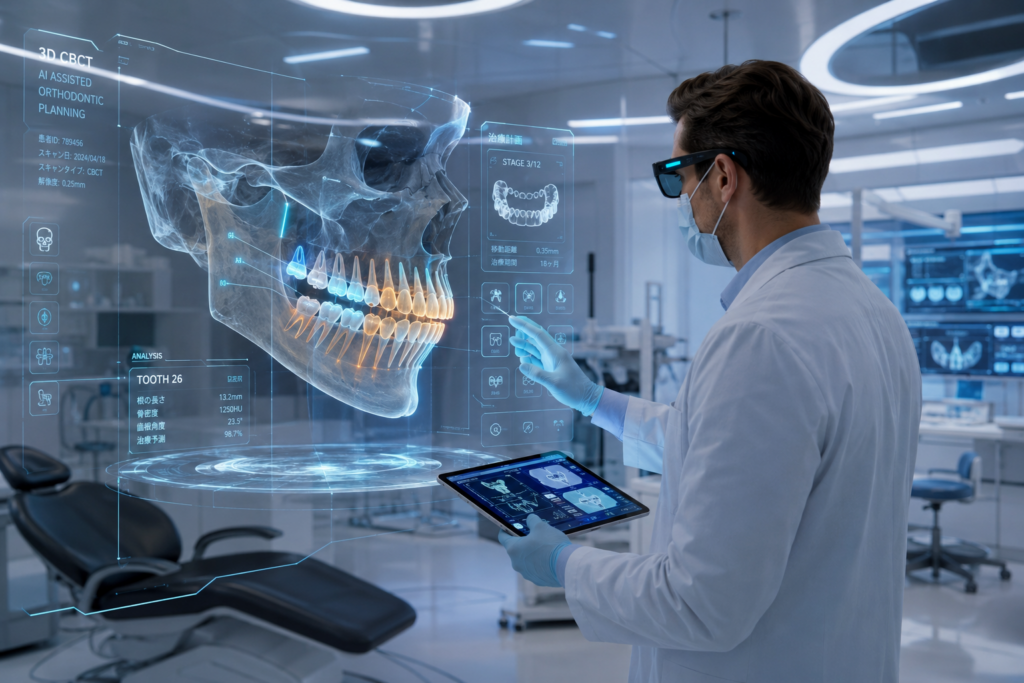
3D dental annotation is quietly reshaping modern dentistry. From aligners to implants and surgical planning, accurate scan interpretation is becoming essential for predictable outcomes.
As AI adoption grows in dental workflows, precise labeling of 3D scans ensures that every tooth, root, and anatomical structure is consistently mapped for clinical and research use.
Why 3D Dental Annotation Matters
- Improves accuracy in orthodontic planning and aligner design
- Supports implant positioning with better spatial understanding
- Enables safer and more predictable surgical guide creation
- Helps standardize interpretation across large volumes of dental scans
- Strengthens AI-driven dental innovation and diagnostics
The Challenge
Handling thousands of CBCT and intraoral scans requires extreme consistency. Manual variation can affect downstream outcomes in planning, simulation, and product development.
How Marteck Solutions Can Help
Marteck Solutions provides specialized medical annotation and labeling services tailored for dental and radiology applications.
Their support can help by:
- Delivering precise 3D dental scan labeling for teeth, roots, and jaw structures
- Ensuring high consistency across large-scale imaging projects
- Supporting orthodontic, implant, and surgical planning workflows
- Enabling faster development cycles for AI-driven dental applications
- Improving the reliability of clinical-grade imaging outputs
Final Thought
As dentistry moves toward AI-assisted planning, the foundation will always be high-quality, well-structured imaging interpretation.
Would patients trust AI-designed orthodontic treatments? Increasingly, the answer is yes—when the underlying data is precise and clinically reliable.
If you’re exploring scalable and accurate dental annotation support, connecting with Marteck Solutions can be a strong step forward.